Anatomy of an extension
An extension consists of a collection of files, packaged for distribution and installation. This article describes the files that may be present in an extension.
manifest.json
This file is the only one that must be present in every extension. It contains basic metadata, such as its name, version, and required permissions.
The manifest can also contain pointers to several other file types:
- Background scripts
-
Scripts that respond to browser events.
- Icons
-
For the extension and any buttons it might define.
-
HTML documents that provide content for various user interface components.
- Content scripts
-
JavaScript included with your extension, which your extension injects into web pages.
- Web-accessible resources
-
Packaged content made accessible to web pages and content scripts.
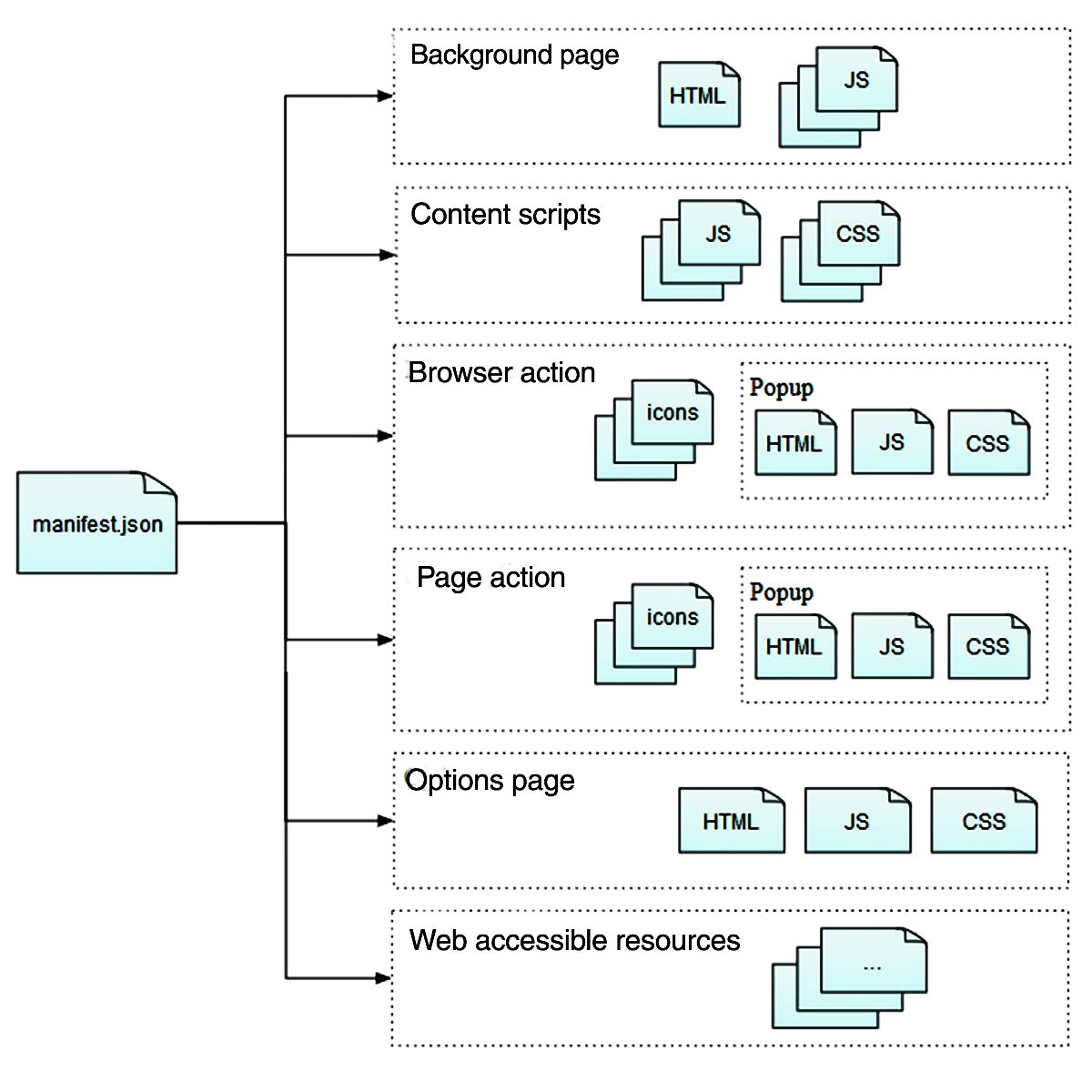
See the manifest.json reference page for all the details.
Along with those listed in the manifest, an extension can include additional Extension pages and supporting files.
Background scripts
Extensions often need to respond to events that occur in the browser independently of the lifetime of any particular web page or browser window. That is what background scripts are for.
Background scripts can be persistent or non-persistent.
- Persistent background scripts load as soon as the extension loads and stay loaded until the extension is disabled or uninstalled. Only Manifest V2 extensions can use persistent background scripts.
- Non-persistent background scripts load when needed to respond to an event and unload when they become idle. Manifest V3 extensions use non-persistent background scripts only, and Manifest V2 extensions can opt in to this behavior.
You can use any of the WebExtensions APIs in the script, if you've requested the necessary permissions.
See the background scripts article to learn more.
Sidebars, popups, and options pages
Your extension can include user interface components defined using an HTML document:
-
A pane displayed at the left of the browser window, next to the web page.
- Popup
-
A dialog displayed when the user clicks on a toolbar button or address bar button
- Options
-
A page shown when the user accesses your add-on's preferences in the browser's native add-ons manager.
For each of these components, you create an HTML file and point to it using a specific property in manifest.json. The HTML file can include CSS and JavaScript files, just like a standard web page.
All of these are Extension pages. Unlike a normal web page, your extension's JavaScript can use the same privileged WebExtensions APIs as your background script.
Extension pages
You can also include HTML documents in your extension that are not attached to some predefined user interface component. Unlike the documents you might provide for sidebars, popups, or options pages, these don't have an entry in manifest.json. However, they do also get access to all the same privileged WebExtensions APIs as your background script.
You'd typically load a page like this using windows.create() or tabs.create().
See Extension pages to learn more.
Content scripts
Use content scripts to access and manipulate web pages. Content scripts are loaded into web pages and run in the context of that particular page.
Content scripts are extension-provided scripts that run in the context of a web page; this differs from scripts loaded by the page itself, including those provided in <script> elements within the page.
Content scripts can access and manipulate the page's DOM, like any other scripts loaded by the page. However, unlike normal page scripts, content scripts can:
- Use a small subset of the WebExtensions APIs.
- Exchange messages with their background scripts, which a content script can use to request the background script to do something using a WebExtensions API.
Content scripts cannot directly access normal page scripts, but can exchange messages with them using the standard window.postMessage() API.
Your extension can also inject CSS into web pages using the mechanism used to inject content scripts.
See the content scripts article to learn more.
Web accessible resources
Web accessible resources are resources—such as images, HTML, CSS, and JavaScript—that you include in the extension and want to make accessible to content scripts and page scripts. Resources made web-accessible can be referenced by page scripts and content scripts using a special URI scheme.
For example, if a content script wants to insert images into web pages, you can include them in the extension and make them web-accessible. Then the content script could create and append img tags which reference the images via the src attribute.
To learn more, see the documentation for the "web_accessible_resources" manifest.json key.